The most dangerous period for a promising company is not the initial struggle. It is the first wave of genuine success. That is when coordination, not competition, becomes the primary adversary. New hires pour in, departments form like continents drifting apart, and the shared mental model that once guided a small team shatters. You will feel it in the lengthening pauses in meetings, the proliferation of parallel projects, and the quiet resignation that “this is just how it is at our size.” It is a lie. Scaling does not require chaos. It requires a conscious architecture for execution, built not on bureaucracy but on a few profound simplicities.
In plain terms: high-growth companies lose alignment when shared context disappears. The cure is not more communication. It is a small execution framework, an explicit system for what we’re doing, how we’ll talk about it, and how decisions get made, so teams can move quickly without drifting apart. An execution framework, in this sense, is not a tool or a process. It is a set of shared constraints: one source of truth, a predictable rhythm, and a clear decision protocol. Its purpose is to preserve alignment as the organization grows faster than its informal habits can hold.
The Tyranny of the Missing Artifact
We often mistake communication for alignment. More Slack channels, more all hands, more report sharing. This is the wrong pursuit. Alignment is not about volume of information; it is about shared context. And shared context cannot exist without a single, authoritative artifact. This artifact is your source of truth. It is the one place where the current battle plan lives. Not in a deck from last quarter, not in a founder's head, not in divergent team notes. It is a living document, a dashboard, a prioritized list so simple and central that ignoring it is harder than using it.In our work, we see companies drowning in data but starving for this very thing. They have a dozen metrics platforms but cannot answer “what are we doing this month and why?” with one answer. The first discipline, the non-negotiable one, is the creation and ruthless maintenance of this artifact. It is the company's nervous system. Everything else is just noise.
Rhythm as a Choice
With a source of truth established, you must build a heartbeat around it. Most companies have a meeting problem. They do not have a rhythm. There is a profound difference. A rhythm is a predictable sequence of conversations, each with a distinct purpose, format, and outcome. A daily sync is not for problem solving. It is a ten-minute pulse check for blockers. A weekly tactical is not for strategic debate. It is a forty-minute commitment to the next seven days of work, directly against the source of truth. A monthly strategic is not a status update. It is a conscious step back to ask if the map still matches the territory, using data to challenge assumptions. When these rhythms blur, the entire organization slows. The weekly becomes a meandering rehash of the daily. The monthly becomes a presentation marathon devoid of decision. Clarity vanishes. To prevent this, you must be monastic in your defense of each rhythm's purpose. Cancel the meeting if the artifact is not updated. End on time, always. This discipline creates spaciousness. It creates trust. People know when and where decisions will be made, so they can stop worrying and start working.
Deciding How to Decide
This is the silent killer of velocity. A team can have perfect clarity and flawless rhythm, but if no one knows how a decision is made, everything stalls. The most pernicious phrase in a growing company is “let's take that offline.” It is a confession that the decision protocol has broken down. You must name your decision-making patterns. For a technical architecture choice, is it a single accountable engineer with a council of advisers? For a product feature, is it the product manager with a veto from engineering? The model matters less than the explicit, social agreement on the model. I favor simple frameworks like DACI because they assign nouns to people: who is the Driver, who must Approve, who Contributes, who is Informed. This is not corporate formality. It is a liberation tool. It grants the Driver the autonomy to run a process and the Approver the clear authority to say yes or no. It tells Contributors their input is valued but not a vote. It ends the endless consensus seeking that masquerades as collaboration. When everyone knows how the decision will be made, the debate becomes richer, faster, and less political.
The Discipline of Subtraction
An execution framework is not something you add. It is something you impose to subtract. You subtract uncertainty. You subtract redundant communication. You subtract decision paralysis. The goal is to create a field of predictable execution where talented people can apply their full creative energy to hard problems, not to navigating internal friction. This requires a leader's constant vigilance. The framework itself is simple. The commitment to it is hard. It feels rigid at first. It feels like overkill for the “simple” problem. That is the point. You are not building for today's simple problem. You are building the neural pathways for the complex organization you are becoming. At Syntaxia, we view this as engineering. It is the engineering of human coordination. We apply the same principle to data systems: structure and clarity must be imposed on chaos to create value. The companies that scale well are not those with the most brilliant individuals, but those that have learned to think together, decide cleanly, and move as one system. They have built a rhythm, and the rhythm carries them forward.
About the Art
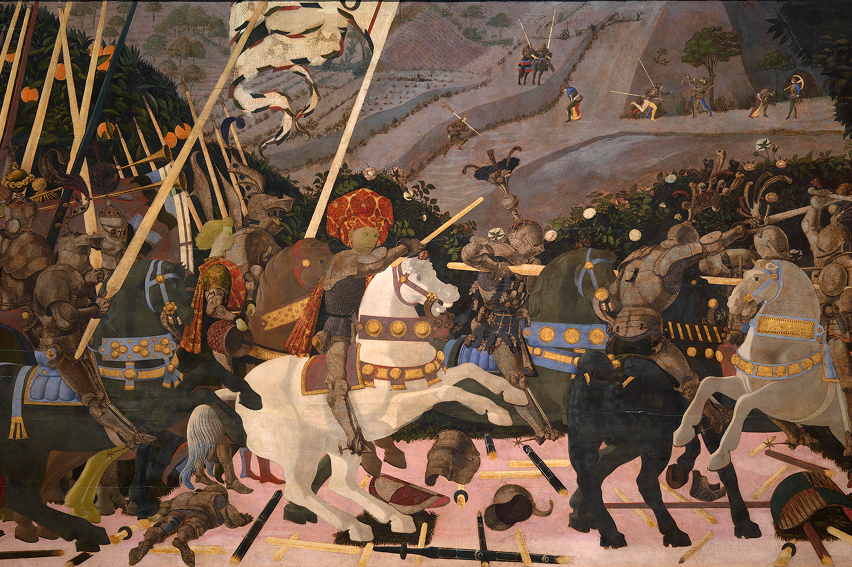
In The Battle of San Romano (c. 1438–1440), Paolo Uccello is obsessed with order under pressure. Every lance, horse, and line of movement is arranged to make a chaotic event executable. Nothing here is expressive for its own sake. The geometry is doing the work. That discipline fits an article about execution during high growth. When teams scale, the problem is not effort or talent. It is coordination at speed. Uccello’s composition reflects what an execution framework does at its best: impose structure early so movement stays aligned when things accelerate.
Credits: http://www.nationalgallery.org.uk/paintings/paolo-uccello-the-battle-of-san-romano